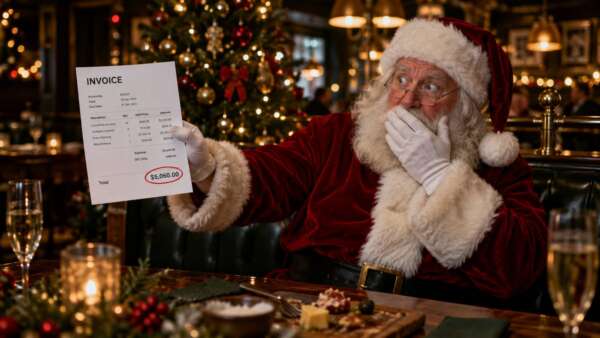
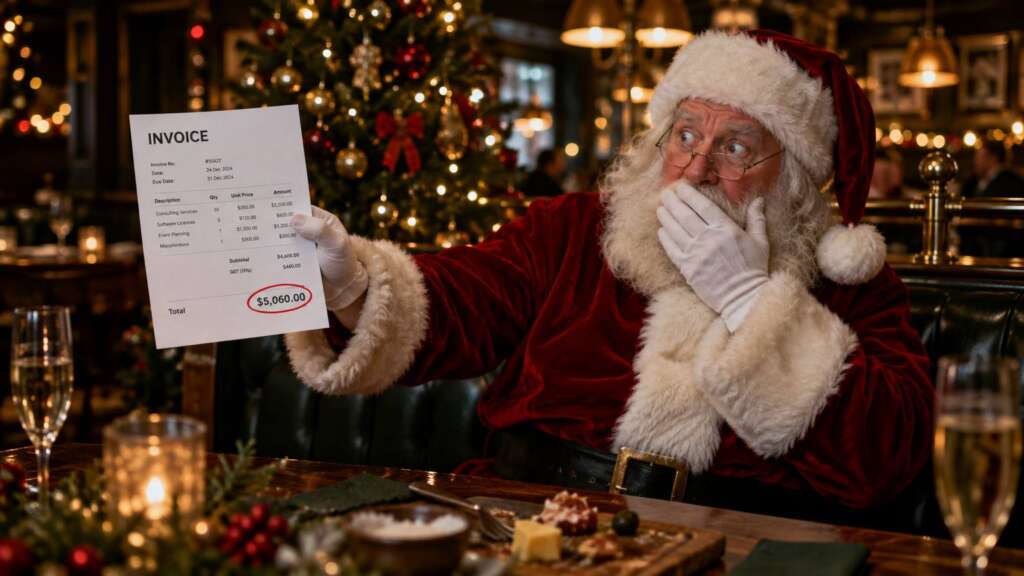
Most business owners think the Christmas party is a tax deduction. In the version that’s cheapest for you, it isn’t. And one extra dollar on the per-head price can turn a tax-free night into a four-figure FBT bill.
The tax-smart Christmas party is usually the one you can’t claim.
That sounds backwards, so here’s the logic. Fringe benefits tax (FBT) is a tax on perks you give employees. Food and drink at a party is “entertainment”, and entertainment sits at the centre of the rules. If your party is exempt from FBT, you pay no FBT, but you also can’t claim a deduction or GST credits. If it’s not exempt, you can claim both, but you pay FBT at 47% on a grossed-up amount that more than wipes out the benefit.
The ATO reminded employers on 11 November 2026 to think about venue, timing, guest list, cost per person and gifts before booking, not after. This post shows you where the line sits, and what crossing it costs.
Quick-read summary
👉 At the office, on a working day: food and drink for employees is FBT-free, with no per-head cap.
👉 Off-site: it’s FBT-free only if it’s a minor benefit, meaning under $300 per person and unreasonable to treat as a fringe benefit. Exactly $300 fails.
👉 At $300 or more a head: FBT applies at 47% on a grossed-up value. You can then claim the deduction and GST credits, but the true cost is far higher.
👉 Clients: never attract FBT, and are never deductible either.
👉 Rates for parties held this December (FBT year 1 April 2026 to 31 March 2027): 47% FBT, with gross-up rates of 2.0802 (you can claim GST credits) and 1.8868 (you can’t).
Planning something bigger than usual this year? Talk to us before you book.
The $300 cliff: one dollar, about $125
Off-site parties are tested under the minor benefits exemption. The benefit’s value has to be less than $300 per person, so a $300 head fails. It also has to be unreasonable to treat the party as a fringe benefit. A once-a-year Christmas party usually passes that second test. Regular staff lunches don’t.
Here’s what that threshold does to a business that can claim GST credits and pays 25% company tax:
| Cost per head (GST-inclusive) | FBT per head | True cost per head after tax |
|---|---|---|
| $299 | $0 | $299 |
| $300 | $293.31 | $424.53 |
| $330 | $322.64 | $466.98 |
So roughly $125 of extra true cost for the last dollar. FBT on a $330 head is $330 × 2.0802 × 47% = $322.64, matching the worked example in the ATO’s entertainment scenarios. The deduction and GST credits you get back don’t come close to covering it.
The minor benefits threshold is a cliff, not a slope.
Move the slider past $300 and watch the bill change.
The table assumes a GST-registered company on the 25% base rate. The calculator lets readers change both, and shows the whole-party cost with their own headcount.
The deduction paradox
The ATO is blunt about it: if the Christmas party isn’t subject to FBT, you can’t claim an income tax deduction for it. GST credits follow the same result. Exempt party, no deduction, no credits. Taxable party, deduction and credits, plus the FBT bill.
That flips a common instinct. Plenty of owners book the bigger venue because “it’s all tax-deductible anyway”. Technically a $330-a-head party is deductible. But for every $1 of tax benefit you pick up, you’ve handed back far more in FBT.
Stop asking “can we claim it?” and start asking “can we keep it FBT-free?”
For most small and medium businesses, the answer is yes. Keep the per-head cost under $300, hold it once a year, and the party costs you what the venue charges. No more, no less.
Who triggers what: office, venue and clients
Where you hold the party and who you invite decide the outcome. Partners and other associates are measured separately from employees, and their share is never added to the employee’s when testing the $300 limit.
| Scenario (cost per head) | FBT | Tax deduction | GST credits |
|---|---|---|---|
| In office, working day, employees only (any cost) | No | No | No |
| In office, partners attending (under $300) | No | No | No |
| Off-site, employees and partners (under $300) | No | No | No |
| Off-site, employees and partners ($300 or more) | Yes, 47% on grossed-up value | Yes, plus the FBT paid | Yes |
| Clients, anywhere | No | No | No |
The office option is the quiet winner. Food and drink for current employees on your premises on a working day is exempt from FBT, and the ATO sets no per-head dollar cap. In the ATO’s own example, a $125-a-head office lunch for employees, partners and clients attracts no FBT for anyone.
The catch is the words “working day” and “your premises”. A hired function room isn’t your premises, and a Saturday night in the office for a Monday-to-Friday team may not qualify. If your trading pattern is unusual, ask us first.
A worked example: the $31 that costs $4,703
Take a hypothetical business, Burleigh Coast Plumbing. It’s a GST-registered company on the 25% base rate. It has 20 staff, and 8 partners are coming. The function centre quotes $330 a head, GST-inclusive.
| Venue at $330 a head | Trimmed to $299 a head | |
|---|---|---|
| Paid to the venue (28 people) | $9,240 | $8,372 |
| FBT payable | $9,033.92 | $0 |
| Deductions and GST credits | Claimed | None |
| True cost after tax | $13,075 | $8,372 |
Trimming $31 a head, by cutting the bar tab or the canapé upgrade, saves about $4,703. The party the owner thought was “fully deductible” costs 56% more once the FBT is counted.
Same guest list, same night, and a $4,700 difference.
If the venue has already quoted $310 a head, the fix is a conversation, not a cancellation. Ask for a set menu, a shorter drinks package, or a split bill so that client costs sit separately. The calculator above lets you test options before you sign.
Burleigh Coast Plumbing is an illustrative example only. Figures assume Type 1 gross-up (2.0802), FBT at 47% and a 25% company tax rate.
Four traps that catch good businesses out
1. The 50/50 method switches off your exemptions
Many businesses elect the 50/50 split for meal entertainment because it’s simple. The catch: under that method the minor benefits exemption isn’t available, and there’s no carve-out for on-premises food. All meal entertainment goes into one bucket and FBT applies to half of it. If you chose 50/50 years ago, check it before the party. Your Christmas function may be taxable even at $120 a head.
2. The taxi home
Taxi travel is exempt only when the trip starts or ends at the workplace. In the ATO’s golf-day example, taxi vouchers from a home to pick up clients didn’t qualify, and the $320-a-head event was taxable. Off-site, a ride home from the venue is a separate benefit and is tested against its own $300 limit. If you’re offering rides home, check how they’re handled before you promise them.
3. The whole calendar counts, not just the party
The minor benefits exemption looks at how often similar benefits are provided across the FBT year (1 April to 31 March). One Christmas party passes. Christmas party plus monthly team lunches plus a Melbourne Cup function starts to look regular, and regular benefits can fail the test. The meal and a Christmas gift are each tested against $300 on their own, but all of it counts when judging whether it’s reasonable to exempt. Planning for the end of the year more broadly? See our tax planning advantages for 2026.
4. The client lunch myth
Clients never attract FBT. That’s the good news. The bad news is that client entertainment isn’t deductible and carries no GST credits either. If clients and staff share a table, split the bill by guest type at the venue. Keep a guest list. The seating plan is also the tax plan.
Records matter more than rates: who came, what each group cost, and what the invoice covered.
Before you book: six checks
- Venue: office on a working day, or off-site? Off-site means the $300 test applies.
- Cost per head: total cost divided by people attending, including food, drinks, venue hire, entertainment and transport. Keep it under $300.
- Guest list: staff, partners and clients counted separately, and clients billed separately where you can.
- Method: are you on the actual method or the 50/50 method for meal entertainment?
- Frequency: is this the only event of its kind this FBT year?
- Gifts: is each gift under $300 per person, and have we checked whether it’s a hamper or a ticket?
The bottom line
A good Christmas party and a clean tax result aren’t in conflict. The office or a sub-$300 venue gives you both. What costs money is booking first and asking later, because by then the quote, the guest list and the invoice are already locked in.
Check the number before you sign the booking.
Not sure which side of the line you’re on, or whether your business uses the 50/50 method? Contact the Keypoint team and we’ll run the numbers with you before you book.
Frequently asked questions
Is our staff Christmas party tax deductible?
Only if it attracts FBT. An FBT-exempt party, whether in the office or off-site under $300 a head, is not deductible and carries no GST credits. A party at $300 or more a head is deductible, and you also pay FBT on it.
Do we pay FBT on a Christmas party at a restaurant or function centre?
Not if the cost is under $300 per person and it’s unreasonable to treat it as a fringe benefit, which a once-a-year party usually is. At $300 or more, FBT applies to employees and their partners. Clients are excluded.
Is there a per-head limit for a party at the office?
No. Food and drink for current employees on your premises on a working day is exempt from FBT with no dollar cap. Partners attending are exempt only as a minor benefit, under $300 each.
Do partners and clients count towards the $300?
Partners and other associates are measured separately from the employee. Clients never attract FBT, but costs for clients aren’t deductible and don’t carry GST credits.
Can we claim GST credits on the Christmas party?
Generally only on a party that is a taxable fringe benefit. You can’t claim GST credits on an FBT-exempt party or on entertainment for clients.
What if we use the 50/50 method for meal entertainment?
The minor benefits exemption isn’t available under the 50/50 method, and there’s no on-premises carve-out. FBT applies to 50% of all meal entertainment. Check which method you use before you book.
Are Christmas gifts FBT-free?
A gift under $300 per person is FBT-free if it’s unreasonable to treat it as a fringe benefit. It’s tested on its own, separately from the party.
This article is general information only and does not constitute tax, financial or legal advice. Rules and rates are based on ATO guidance checked in November 2026 and apply to commercial employers for parties held in the FBT year 1 April 2026 to 31 March 2027. Not-for-profits and government bodies follow different rules. Please seek advice on your own circumstances before you rely on this information.
Sources
- ATO: Staff parties, events and gifts: have you considered FBT? (published 11 November 2026)
- ATO: Common entertainment scenarios for business (last updated 12 January 2023)
- ATO: Minor benefits exemption
- ATO: Fringe benefits tax rates and thresholds (last updated 20 May 2026)
- Andersen Australia: Entertainment and gifts in FBT, 2026 (the 50/50 method and per-year minor benefit tests; secondary source)