
Payday Super: Article At A Glance
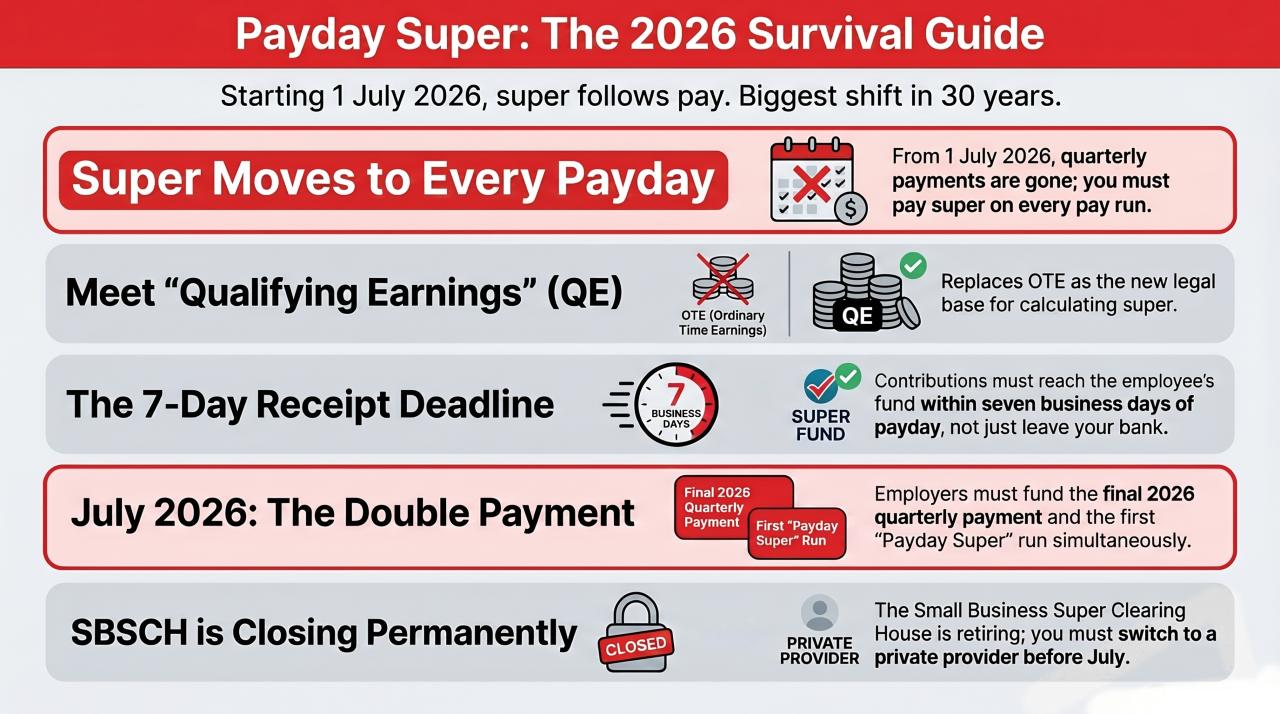
- From 1 July 2026, employers must pay super on every payday — quarterly payments are gone for good.
- Super contributions must reach the employee’s super fund within seven business days of payday, not just leave your bank account.
- Super is now calculated on Qualifying Earnings — a new term that replaces Ordinary Time Earnings as the calculation base.
- July 2026 will be a double-payment month for most employers, with the final quarterly payment and first Payday Super contributions running simultaneously.
- The Small Business Super Clearing House is closing — find out what you need to switch to before the deadline.
Payday Super is the biggest change to Australia’s superannuation system in years, and 1 July 2026 is a date no employer can afford to ignore. The ATO has been rolling out detailed guidance, and understanding these changes now gives your business the best chance of staying compliant from day one. Every employer running payroll is affected — regardless of business size.
Quarterly Super Ends on 30 June 2026
The core premise is simple: every time you pay your employees, you also pay their super. No more holding contributions until the end of the quarter.
From 1 July 2026, super is tied directly to your pay run. Pay weekly? Super is due weekly. Pay fortnightly? Super is due fortnightly. Here’s the detail the ATO has been emphatic about: the contribution must be received by the employee’s super fund — not just dispatched from your bank account — within seven business days of payday. That distinction matters enormously for compliance. You need to build in enough lead time to account for fund processing, clearing house delays, and any SuperStream rejections that may bounce a payment back to you.
The transition is clean and date-specific: paydays before 1 July remain under the existing quarterly rules; paydays on or after 1 July fall under Payday Super. The pay date is the determining factor — not the period the pay covers.
The 12% Super Guarantee rate is not changing. What changes is how and when it is calculated and paid.
The 5 Key Changes Employers Must Know
Here is a clear breakdown of what is actually changing under Payday Super, so nothing catches you off guard when July arrives.
1. Super Is Paid Every Payday, Not Quarterly
The most fundamental shift. Super must be paid on every single payday and received by the super fund within seven business days — whether you pay weekly, fortnightly, or monthly. Quarterly is no longer an option from 1 July 2026.
2. Super Is Now Calculated on Qualifying Earnings
Qualifying Earnings (QE) is the new earnings base replacing Ordinary Time Earnings (OTE). It brings together what was previously calculated under OTE and other eligible payments into a single, clearer definition — applied at every individual pay run, not reconciled at quarter’s end.
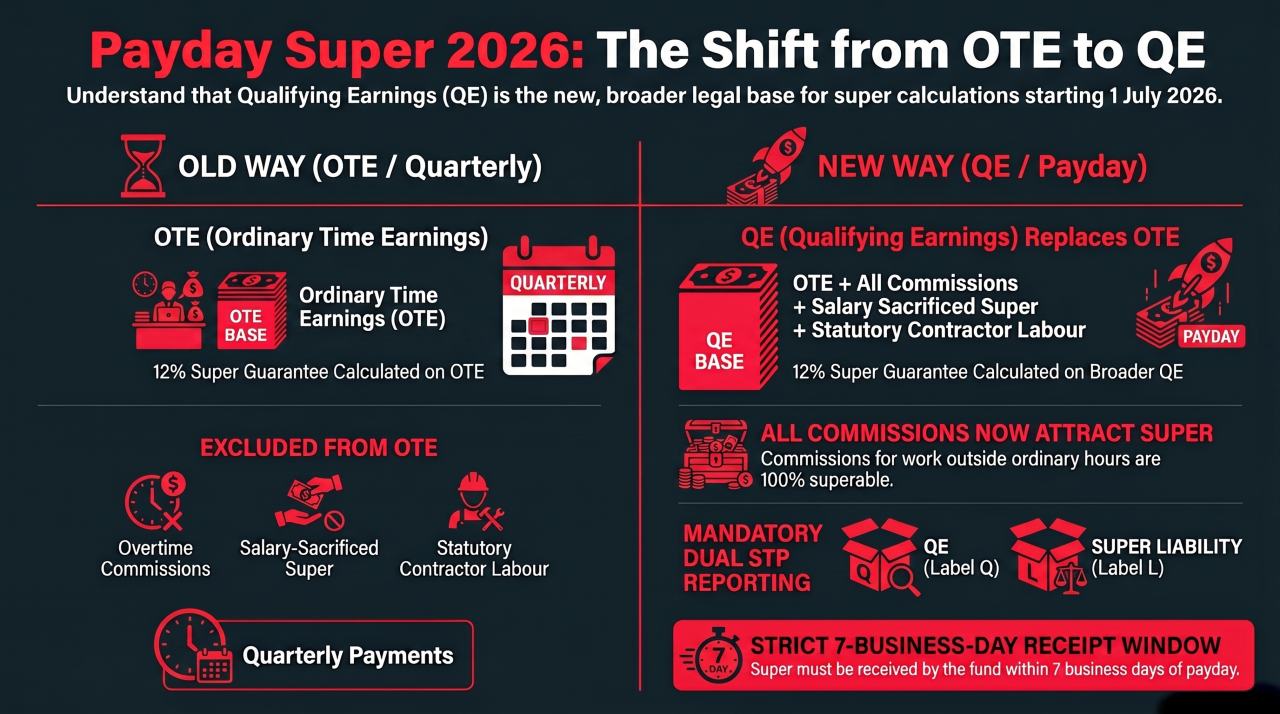
Under the old system, the quarterly deadline gave employers a buffer to catch errors. Under Payday Super, each payday is its own compliance event. Payroll software must correctly identify and calculate QE in real time — mistakes flow directly into the super amount paid, with no quarterly window to fix them.
3. Qualifying Earnings Must Be Reported Through Single Touch Payroll
Every pay cycle, employers must report QE and the associated super liability through Single Touch Payroll (STP) reporting. This needs to be embedded into your regular payroll workflow — not handled separately or manually. The ATO receives this data in real time, which means discrepancies between what’s reported and what’s paid will be visible almost immediately.
If your STP reporting has had minor warnings or inconsistencies in the past, resolve them now. What the ATO previously flagged as warnings become hard rejections under the upgraded SuperStream framework that supports Payday Super.
4. New Super Guarantee Charges Apply on Every Missed Pay Run
The Super Guarantee Charge (SGC) has always been the penalty for late or missing super — but under Payday Super, it can now apply on every single missed pay run, not just quarterly. The charge includes the unpaid super amount, interest, and an administration fee. Critically, it is not tax deductible — unlike regular super contributions — which makes late payment significantly more expensive than simply getting it right. The financial exposure multiplies quickly for any employer who falls behind.
5. The Small Business Super Clearing House Is Closing
The SBSCH — the free ATO-run service many small businesses have used to batch and submit super payments — is closing. It was never designed to handle the speed and frequency that payday-aligned contributions require. Small businesses need to find a compliant replacement before 1 July 2026. Your options are covered in the section below — the earlier you act, the better positioned you will be.
July 2026 Will Be a Double-Payment Month
Here is something that has caught many employers off guard when they first hear about the transition: July 2026 is going to be a heavier month for super payments than usual.
Your final quarterly super obligation — covering April, May, and June 2026 — is still due under the existing rules. That quarterly payment deadline sits alongside your very first Payday Super obligations for any pay runs that fall on or after 1 July. For most employers, both will land in the same month, creating a temporary cash flow pressure that requires advance planning. The final quarterly payment is calculated under the old OTE-based rules — business as usual right up until 30 June.
Plan for the July cash flow pressure before it arrives — not after.
The ATO has also flagged a specific consideration for employers with high-earning staff: some employees may find the close succession of their final quarterly contribution and their first Payday Super payment pushes them toward or over their concessional contributions cap for FY2027. It will affect a relatively small number of workers, but worth being across if it applies to anyone on your payroll.
Small Business Super Clearing House Closure: What to Do
With the SBSCH closing, small businesses need a replacement solution that is SuperStream-accredited, capable of processing contributions within the seven business day window, and integrated with your STP reporting setup. The most convenient route is the built-in clearing house functionality within your existing payroll software:
- Xero offers Auto Super — automating super calculations and payments directly within the existing payroll workflow.
- MYOB offers Pay Super — “Simply switch on the Pay Super setting ahead of July 1 Payday Super changes, and we’ll handle the rest.”
- QuickBooks integrates with two third-party clearing house providers: Beam and HeroClear.
For those who prefer a standalone SuperStream-compliant clearing house:
- Wrkr (formerly ClickSuper): SuperStream and STP services, widely used for SBSCH migration.
- SuperChoice: A major digital gateway used by prominent Australian super funds and employers.
- SCH Online: Per-transaction pricing model with no monthly or setup fees.
Do not wait until the SBSCH closes before making the switch. Testing your new setup on a live pay run before 1 July gives you the chance to catch and resolve any issues before they become compliance problems under the new rules.
How to Prepare Before 1 July 2026
The businesses that handle Payday Super best are the ones that treat preparation as a payroll project now — not a last-minute admin task in June. There are four clear areas to work through.
Talk to your payroll provider now, not later. Most providers should already have Payday Super updates and support materials ready. Contact them directly and ask specifically how Qualifying Earnings will be calculated in your system, and whether your current plan or licence tier includes the upgraded STP and SuperStream functionality. Some providers are rolling out updates progressively — do not assume an automatic update makes you fully compliant on day one. Xero Payroll, MYOB AccountRight, and KeyPay have all been working toward Payday Super readiness, but confirm the specifics directly with each provider rather than assuming.
Clean up your SuperStream data before rejections cost you compliance time. Log into your clearing house or payroll platform and pull up contribution history from the past 12 months. Look specifically for warning messages, unmatched fund details, or contributions that required manual correction. Under the upgraded SuperStream validation rules coming with Payday Super, those warnings become hard rejections — and a rejected message means the contribution has not been made, while the seven-day clock is still ticking. Fix the underlying data now: update fund USIs and member numbers, and ensure legal names, dates of birth, and tax file numbers match what each fund holds on record.
Confirm your clearing house is genuinely Payday Super-ready. Not every service processes at the same speed. The New Payments Platform (NPP) enables near-real-time bank transfers, and super funds are increasingly integrating with it — but not every fund is there yet. Building in a one-to-two day buffer on your own processing time is sensible practice, particularly in the early months.
Plan your cash flow for July. Factor in the double-payment month — both the final quarterly contribution and your first Payday Super obligations will land in July. Treat this as a payroll project now, not a last-minute admin item.
Payday Super Is Good News for Employees
While most of the preparation burden sits with employers, it is worth remembering why this change exists. Research has consistently shown that unpaid and late super is a significant problem in Australia, with billions in entitlements going missing each year. Paying super on every payday means employees receive contributions faster, those funds enter the super system sooner, and compound growth works in the employee’s favour over a longer period. For a worker in their 20s or 30s, the difference between quarterly and payday super contributions — compounded over decades — can translate to a meaningfully larger retirement balance. Payday Super closes the gap between what employees are owed and what they actually receive.
Frequently Asked Questions About Payday Super
When Does Payday Super Start?
Payday Super starts on 1 July 2026. Any payday falling on or after that date is subject to the new rules. Pay runs that fall before 1 July — including June pay runs — are still governed by the existing quarterly system. The transition point is the pay date itself, not the period the pay covers.
Does the 12% Super Rate Change Under Payday Super?
No. The Super Guarantee rate stays at 12%. What changes is the frequency of payment and the earnings base — QE applied at each individual pay run rather than OTE reconciled quarterly.
What Happens if Super Is Not Paid on Time?
If super is not received by the employee’s super fund within seven business days of payday, the employer may be liable for the Super Guarantee Charge (SGC). That charge includes the unpaid super amount, interest, and an administration fee — and it is not tax deductible, which makes late payment significantly more expensive than simply getting it right. Under Payday Super, the SGC can apply on every single missed pay run, so the financial exposure compounds quickly for employers who fall behind.
What Is Qualifying Earnings and How Is It Different From OTE?
Qualifying Earnings (QE) is the new earnings base introduced under Payday Super to calculate Super Guarantee contributions. It brings together what was previously classified under Ordinary Time Earnings (OTE) and other eligible payments into a single, clearer definition applied at each pay cycle. The key practical difference: QE is calculated and locked in at every payday in real time — there is no quarterly window to reconcile and adjust. Payroll systems must correctly classify all payments, including wages, allowances, and bonuses, against the QE definition from the very first Payday Super pay run.
What Should Small Businesses Do Now That the SBSCH Is Closing?
The first step is to identify a compliant replacement clearing house or payroll platform, then migrate your employee super fund details carefully — using the transition as an opportunity to audit and clean your data at the same time. Modern payroll platforms including Xero, MYOB, QuickBooks, and KeyPay all have built-in clearing house functionality that meets Payday Super requirements. Test your new setup on a live pay run before 1 July, and do not wait for the SBSCH to actually close before making the switch.
Staying across these changes is critical for every Australian employer — explore the resources available to ensure your business is fully prepared for Payday Super from day one.