Australia’s Dangerous Fuel Dependency — and What It Means for Your Business
By now, you’ve made the connection.
The conflict in the Middle East. The price at the pump. The surcharges creeping into your supplier invoices.
Most business owners have a working understanding of the cause. But there’s a significant gap between knowing that this is happening and understanding how — and that gap matters enormously when you’re trying to plan the next six to twelve months of your business finances.
This article is the deeper briefing the news cycle hasn’t given you.
The Chokepoint Most Australians Have Never Previously Thought About
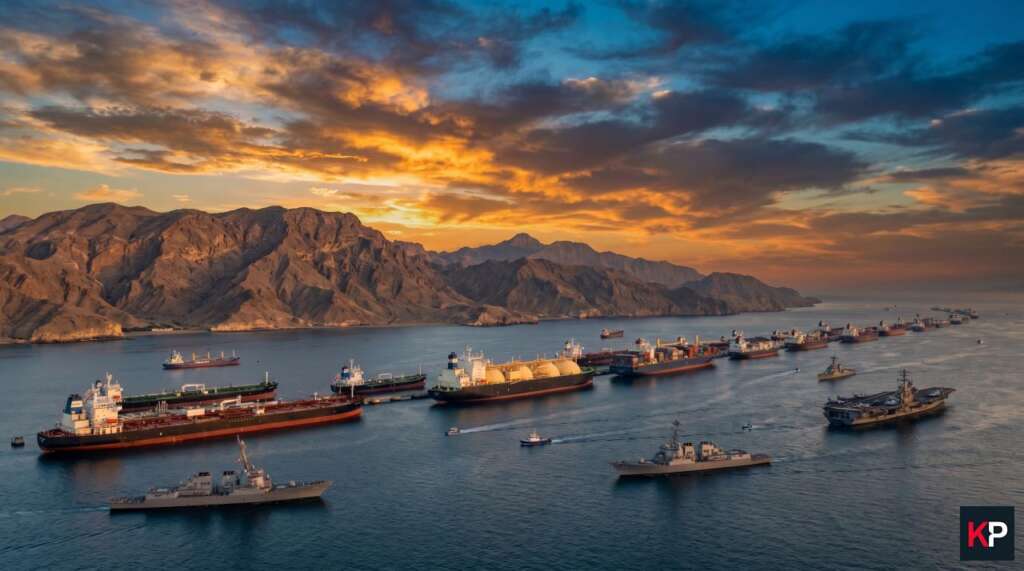
The Strait of Hormuz is a narrow waterway connecting the Persian Gulf to the open ocean.
It is, arguably, the single most economically consequential piece of water on earth.
According to the International Energy Agency, approximately 20 million barrels of crude oil and petroleum products transited the Strait every day in 2025 — equivalent to roughly 20% of global petroleum liquids consumption and around 25% of all seaborne oil trade worldwide. (IEA — Strait of Hormuz)

(Source: Commons.WikiMedia)
In normal times, that fact sits quietly in the background of global commerce, unnoticed and unremarked.
When the United States and Israel launched military operations against Iran in late February 2026, shipping through the Strait effectively ground to a halt. War-risk insurance was withdrawn almost immediately. Freight rates surged. Global oil prices spiked sharply — Brent crude surging to a peak of US$126 per barrel before moderating following emergency IEA reserve releases. (LSE Business Review)
The shockwave was immediate. And it was global.
Australia’s Vulnerability Is Deeper Than Most People Realise
Here is the part that doesn’t make the nightly news.
Australia does not import most of its crude oil directly from the Middle East. So at first glance, you might assume we have some insulation from events in the Persian Gulf.
We don’t.
Australia imports approximately 90% of its liquid fuel — petrol, diesel, jet fuel — predominantly in refined form from Asian refineries. This dependency on imports is structural, long-standing, and well-documented by the Australian Government’s own Department of Climate Change, Energy, the Environment and Water. (DCCEEW — Australia’s Fuel Security)
Those Asian refineries depend heavily on Middle Eastern crude.
Crude that travels through the Strait of Hormuz.
So while Australia sits geographically distant from the conflict, we are structurally embedded in a supply chain that runs directly through it. When the Strait closes, the effect doesn’t stop at the Persian Gulf — it cascades through every refinery in our region, and then directly to our shores.
Compounding this is the state of our domestic refining capacity. In 2025, just two Australian refineries remained operational — Ampol’s Lytton facility in Brisbane and Viva Energy’s plant in Geelong — together producing approximately 12 billion litres of fuel, or around 20% of Australia’s annual needs. The rest must be imported. (Australian Government — Minister for Energy).

Source: https://upload.wikimedia.org/wikipedia/commons
We are, by any honest measure, one of the most fuel-import-dependent developed nations on earth.
And our emergency reserves reflect that reality. The IEA requires member countries to hold stocks equivalent to at least 90 days of net imports. Australia’s current holdings fall well short of that benchmark — a structural deficiency the DCCEEW has been transparent about for years. (DCCEEW — Measures of Liquid Fuel Stocks)
That is the structural backdrop against which every business in this country is now operating.
From the Pump to Your P&L
The petrol price increase is visible. What’s less visible is how fuel costs propagate through the broader economy — and how many of your input costs have fuel quietly embedded within them.
Freight and logistics.
Diesel is the backbone of freight in Australia. It powers every truck on every highway. Surcharges have already appeared across freight, building, and supply chain invoices nationally. According to the Australasian Supply Chain & Logistics Association, average pump prices rose by close to 50 cents per litre since February, with regional Australia bearing the sharpest impact. (ASCLA)
Agriculture and food supply.
Diesel powers farm machinery. The crisis hit at one of the worst possible times — coinciding with critical sowing seasons. Reduced planting efficiency and transport delays are expected to flow through to food prices in the months ahead. Deloitte has specifically flagged fertiliser as a secondary commodity shock from the conflict, given its energy-intensive production. (Deloitte Australia — Business Outlook)
Electricity and gas.
This one surprises people. Australia exports enormous volumes of LNG. Domestic east coast gas prices are directly linked to global LNG export pricing — meaning when international prices spike, local energy costs follow, even when domestic supply levels haven’t changed. The IEA has confirmed that a closure of the Strait also strands Qatari and UAE LNG, representing close to 20% of global LNG exports, with flow-on impacts across Asian energy markets including Australia. (IEA — Strait of Hormuz)
Consumer spending.
Higher fuel costs are a direct tax on household discretionary budgets. Two-car households in outer suburban or regional areas are absorbing the sharpest hit — and that money has to come from somewhere. It comes from discretionary spending. Which means retail, hospitality, and services businesses are facing a demand-side squeeze alongside their cost-side pressures.
This is not a single-line-item problem. It is a whole-of-economy repricing event, and it is still unfolding.
The Macroeconomic Outlook Your Business Plans Need to Reflect
Deloitte Access Economics has warned bluntly that the oil shock has triggered a new business cycle in Australia — one characterised by slower growth, higher inflation, and rising unemployment. (Deloitte Australia — Business Outlook, March 2026)
The firm’s central forecasts are sobering.
CPI is forecast to peak near 4.9% by June 2026 — well outside the RBA’s 2–3% target band.
Another interest rate rise is expected in the June quarter.
GDP growth, which reached 2.6% at the end of 2025, is projected to moderate to 1.8% by December 2026.
Unemployment is forecast to climb toward 4.9% by mid-2027.
Business confidence is softening. Non-essential consumer spending is expected to deteriorate. Firms are likely to delay investment decisions.
None of this is catastrophising. This is the central-case forecast from one of Australia’s most respected economic institutions. It is the environment your business is now operating in, and your financial planning should reflect it.
What Smart Business Owners Are Doing Right Now
This is where preparation separates the businesses that manage through a difficult period from those that don’t.
Review your contracts.
Do your supplier agreements contain fuel or freight escalation clauses? If so, you need to understand what your exposure is and whether those clauses have been triggered. If not, that’s a consideration for your next round of contract negotiations.
Stress-test your cashflow.
Model what your next 6–12 months looks like if input costs remain elevated. Not the worst case — the central case. Know where your breakeven sits under current conditions.
Revisit your pricing.
If your margins were healthy in early 2025, they may not be now. The time to address pricing is before you feel the pain in your bank account, not after.
Understand your fuel tax entitlements.
Many businesses that use diesel off-road — in machinery, generators, or certain vehicles — are entitled to fuel tax credits. If you haven’t reviewed this recently, it’s worth a conversation.
Talk to your lender or broker now.
Another rate rise in the June quarter is a real prospect. If your loan structure isn’t right for that environment, the cost of doing nothing compounds quickly.
Be strategic about any cost-cutting
Prudent cost shaving is appropriate and may be essential, depending on your industry. However, it’s important to try and avoid the initial reaction of panic. Whilst the seriousness of this current “macro” situation cannot be understated, in the course of time, some degree of normality will return – even if not everything returns to exactly how it was before.
It’s important to maintain as much of a medium to longer term view as your business can. For instance, slashing spend on marketing and promotion initiatives often seems attractive in the heat of the moment, but if your company stops all promotion, and your competitor continues with marketing, this may create a downward spiral for your business which could be harder to recover from in the 6 month to two year horizon.
The Bigger Picture
This crisis will ease. Conflicts end, supply chains adapt, and markets find new equilibria.
But this will not be the last geopolitical shock to reach Australian businesses through global supply chains.
The structural vulnerabilities this crisis has exposed — our import dependency, our thin reserves, our hollowed-out domestic refining capacity — were years in the making. They will take years to address, if they are addressed at all.
In the meantime, the businesses that navigate the current environment best won’t necessarily be the ones with the best instincts or the most optimistic outlook.
They’ll be the ones with strong financial foundations, clear visibility of their numbers, and advisors who help them plan ahead rather than react after the fact.
That is precisely what we do.
If you’d like to talk through what the current environment means for your business specifically, get in touch with the Keypoint Accountants team.
Keypoint Accountants is a Queensland-based accounting and advisory firm. This article is general in nature and does not constitute financial advice. Please seek professional advice specific to your circumstances.