
We’ve all felt it. That surge of optimism on New Year’s Day when the calendar resets and everything feels possible. The goals seem achievable, the plans feel solid, and this year – surely this year – will be different.
Then the first Monday arrives.
Look, we’re not here to be cynical about New Year’s resolutions or dampen anyone’s enthusiasm for 2026. But after working with hundreds of Australian business owners over the years, we’ve noticed something that probably won’t surprise you: the intentions set on January 1 rarely survive first contact with a full inbox. A recent piece by business strategist Roland Frasier put it rather bluntly – “January 1 is when motivation spikes. January 5 is when reality shows up. And reality is the only thing that actually determines whether a year works.”
That landed with us. It’s honest. And honestly, it matches what we see every single January.
Where things tend to fall apart
Here’s what typically happens. Business owners return to work energised. They’ve had a break (hopefully), they’ve done some thinking about the year ahead, maybe sketched out a few goals. Good stuff.
Then they open their laptop.
The inbox has 247 unread messages. Slack is lighting up. There’s a compliance deadline someone forgot to mention. A staff member needs an urgent decision. The accountant (that’s us, sorry) has sent a reminder about BAS. And suddenly, that carefully considered plan for Q1 gets pushed aside while you deal with the immediate chaos.
Frasier describes this as the point where “most plans don’t fail loudly, they fail quietly. Not because the goals were wrong, but because the attention system required to execute them was never designed.” We think that’s genuinely insightful, actually. It reframes the whole conversation away from motivation and willpower – which, frankly, most business owners have in spades – toward something more structural.
People don’t lose motivation first. They lose coherence.
The research backs this up too. Studies suggest employees often have 46% less focus time than they actually need to do their work well, even when they’re putting in overtime. For business owners juggling compliance, staff, clients, and strategy simultaneously? That gap is probably worse.
The attention bottleneck nobody talks about
There’s an uncomfortable truth buried in most productivity advice, and it’s this: the constraint isn’t effort. It isn’t hours worked. It isn’t even skill or knowledge.
It’s unfragmented attention.
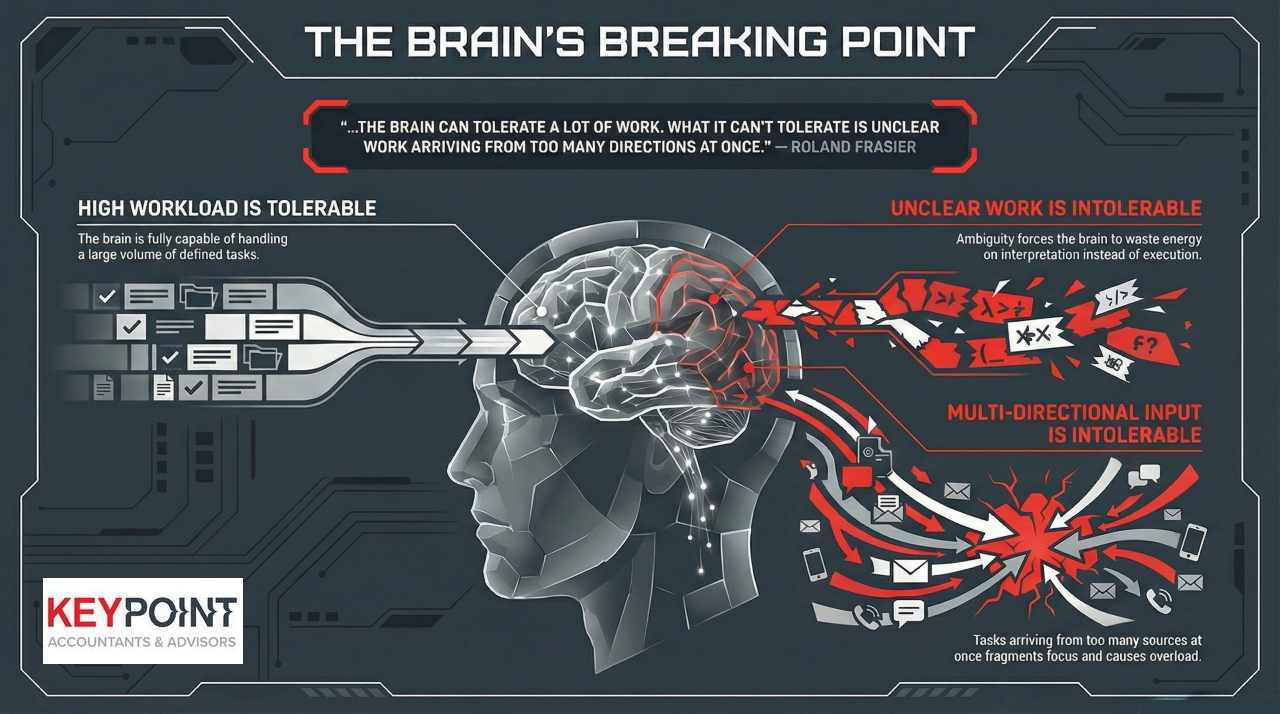
Frasier argues that “the brain can tolerate a lot of work. What it can’t tolerate is unclear work arriving from too many directions at once.” And when you think about the first week back after the holidays, that’s precisely what happens. Context switching. Coordination overhead. Reactive communication flying in from every direction. Priorities that seemed clear on January 1 suddenly competing with seventeen other urgent things.
The American Psychological Association has found that task-switching alone can cost up to 40% of your productive time. Forty percent. That’s not a rounding error. That’s nearly half your week evaporating into the gaps between tasks.
You know that feeling of being exhausted at the end of a Monday despite not doing any “hard” work? That’s cognitive fatigue, not physical tiredness. Your brain has been bouncing between contexts all day, never settling long enough to actually make progress on anything substantial.
For Australian SMEs heading into 2026, this matters enormously. The data tells us that businesses entering the new year are increasingly focused on financial resilience after years of inflation and cost-of-living pressures. But resilience requires focused decision-making. It requires attention. And if that attention gets fragmented in week one, the whole quarter can drift.
Why the first week sets the template
Here’s the thing that caught our attention in Frasier’s analysis. He argues that “by the end of today, one of two things will happen: Either your attention will be claimed – by meetings, messages, and other people’s urgency. Or your attention will be designed – intentionally, with boundaries, sequencing, and protected depth.”
Claimed or designed. Those are very different outcomes.
And whichever happens tends to replicate itself. This is why January “drift” isn’t random – it’s seeded on the first real Monday back. The patterns you establish in week one become the patterns for the month. The patterns for the month shape the quarter. You can see where this is going.
We’ve watched this play out with clients year after year. Some hit the ground running and maintain momentum through to March. Others spend January catching up, February finding their feet, and don’t really start executing until Q2. Same businesses, same industries, similar goals. Different approaches to that first week.
One piece of planning advice we came across recently made this point starkly: waiting until January to start your annual planning means you won’t begin executing until March, leaving you three months behind schedule. Three months. That’s a quarter of your year gone before you’ve properly started.
Where financial clarity fits into this
Now, we’re accountants, so you’d expect us to connect this to finances eventually. But bear with us, because we think there’s a genuine link here.
One thing we’ve observed over and over: business owners with clear financial visibility make faster, better decisions. When you’re not constantly wondering about cash flow, worrying about compliance deadlines, or trying to remember when that BAS is due, you free up mental bandwidth for everything else.
Financial uncertainty is cognitively expensive. It sits in the back of your mind, consuming attention even when you’re not actively thinking about it. Getting ahead of compliance – super deadlines, ATO requirements, quarterly obligations – removes whole categories of “decision fatigue” from your January.
This becomes even more relevant given what’s coming in 2026. Compliance burdens are set to increase with the new PayDay Super rules requiring superannuation contributions to be paid on each payday from July 1. The ATO’s Small Business Superannuation Clearing House is closing, which means SMEs need to find alternative arrangements. These aren’t enormous changes in isolation, but they add up. And every unresolved compliance question is another thing competing for your attention.
The businesses that seem to navigate this best are the ones that sort their financial foundations before the year properly begins. Fresh budget in place. Cash flow forecast done. Compliance calendar mapped out. That way, when January hits, they’re not scrambling to find direction – they’re executing on plans that already exist.
A different question for January
Frasier offers a reframe that we think is genuinely useful. Instead of asking “how do I get through today?” he suggests asking “what, if protected today, changes the trajectory of the entire week?”
That answer is your real priority. Everything else is coordination noise.
It’s a simple question, but it forces clarity. What’s the one thing for your business in Q1 2026? Is it improving cash flow? Sorting out that messy bookkeeping situation that’s been nagging at you? Getting ahead on the new super compliance requirements before they become urgent? Building a proper budget for the first time in years?
Whatever it is, it probably needs protection from the general chaos of week one. Not elimination of the chaos – that’s unrealistic – but deliberate protection of time and attention for the thing that actually matters.
The outlook for Australian SMEs heading into 2026 is cautiously optimistic. Recent surveys show 19% of businesses have seen revenue increases, a four-point rise compared to six months earlier. More businesses are reporting confidence about the year ahead than we’ve seen in a while. But capturing that opportunity requires focus. Scattered attention won’t get you there.
Small adjustments can make a genuine difference here. Simplifying processes. Adopting a digital-first approach where it saves real time. Sharing key metrics across the business so everyone understands what success looks like. None of this is revolutionary, but it compounds.
For those of you leading teams
If you’re running a business with staff, there’s another dimension to this. Your team watches where you direct your attention, especially in the first week of the year.
Frasier puts it well: “Whether you realize it or not, today your team is watching one thing: What do you reward with your attention? Fast replies? More meetings? Immediate alignment? Or: clear priorities, protected focus, thoughtful sequencing.”
Teams don’t follow what leaders say in January. They follow what leaders tolerate.
If you spend week one jumping from fire to fire, responding instantly to every message, never blocking time for strategic thinking – that becomes the cultural expectation. Your team learns that reactive is normal. That depth can wait. That urgency always wins.
But if you model something different – if you protect time for focused work, if you demonstrate that not everything needs an immediate response, if you show that strategic thinking matters – that signals something too.
We’re not suggesting you ignore your team or become unreachable. That’s not leadership either. But there’s a middle ground where you’re responsive without being purely reactive. Where speed matters but doesn’t trump everything else.
Making 2026 count
January 1 is loud. The first Monday back is honest.
Most people react in week one. A few design it. And that small difference compounds for weeks. Frasier’s final point resonates: “If you win control of your attention today, even partially, you don’t just win the day. You quietly win the month.”
We’re not suggesting you can control everything. The inbox will still fill up. Clients will still have urgent requests. Staff will still need decisions. The chaos doesn’t disappear just because you’ve read a thoughtful article about attention management.
But designing even a portion of your first week intentionally can shift the trajectory of your whole January. Protecting one morning for strategic thinking. Sorting one major compliance obligation before it becomes urgent. Having one clear priority that doesn’t get pushed aside by the reactive noise.
The businesses that thrive in 2026 will be those that protect focus, maintain financial clarity, and resist the pull of constant reactivity. The pace of change is only accelerating – global trade disruptions, AI adoption pressures, new compliance requirements, cost challenges that haven’t fully eased. SME owners who apply even basic attention design will be better positioned to navigate what’s coming.
We’re here to help with the financial clarity piece of that equation. Sorted books, clear cash flow visibility, compliance handled before it becomes stressful – these aren’t exciting, but they free up the mental bandwidth you need for everything else. That’s genuinely valuable, even if it doesn’t make for compelling New Year’s content.
Welcome to 2026. The first Monday is behind us now, but the principles still apply. What deserves your protected attention this week? This month? This quarter?
Whatever your answer, that’s where the year actually begins.