
Whilst most of the headlines this month have been about the RBA’s card surcharge on-charge ban for small businesses, a much quieter consequence has landed on the desks of business owners, and it’s one that could catch a lot of people out over the Christmas period.
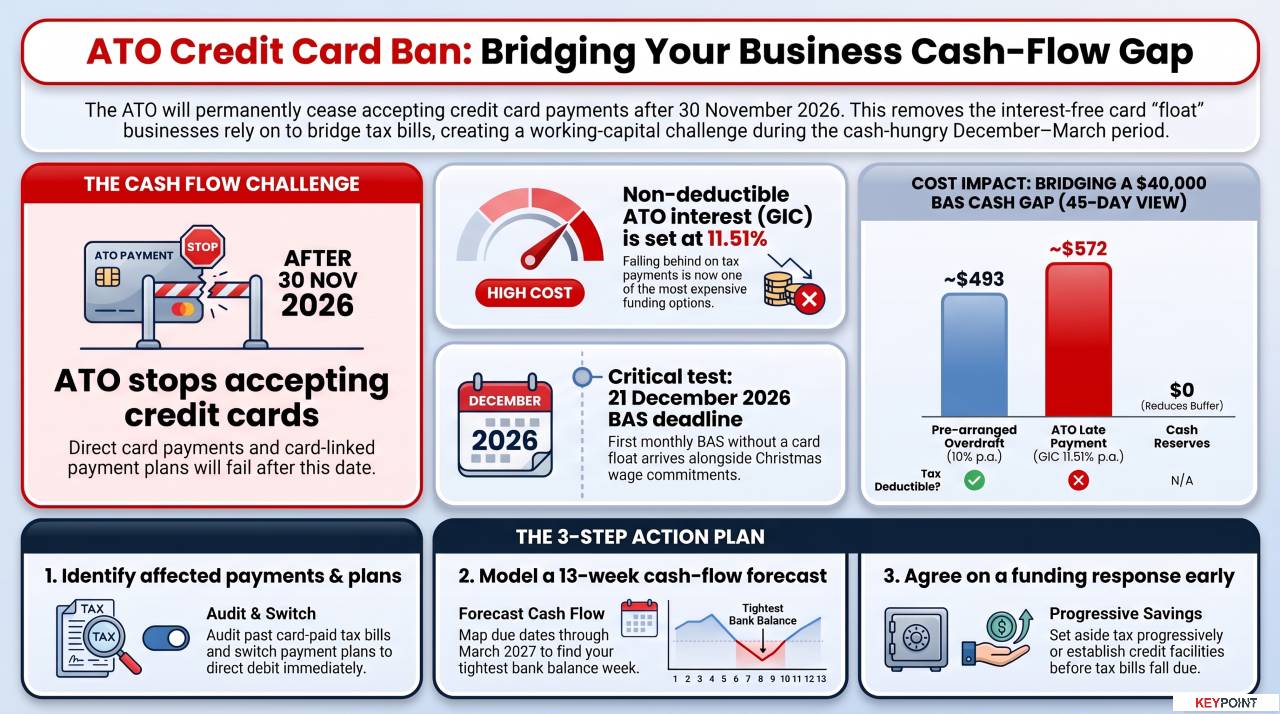
The ATO will stop accepting credit cards as a payment method after 30 November 2026. For most taxpayers that’s a non-event. But for businesses that have quietly relied on a credit card’s interest-free period to bridge a BAS, a PAYG instalment or an ATO payment plan, it’s a genuine cash-flow change. And it arrives just ahead of the most cash-hungry stretch of the business year.
Your tax bill didn’t go up. The day you have to fund it just moved forward.
Quick-Read Summary
- The cut-off: direct credit card payments to the ATO end after 30 November 2026.
- Payment plans: any plan linked to a credit card must be switched to another method before the next instalment, or it risks falling into arrears or default.
- The real issue: if you’ve been using a card’s interest-free days to fund tax, you now have a working-capital gap to plan for.
- The cost of getting it wrong has gone up: ATO interest (GIC) is running at 11.51% a year and is no longer tax-deductible.
- Our three-step plan: Identify your affected payments, Model when the cash must leave your account, and Agree a funding response before the due date.
What the ATO actually announced
On 1 October 2026, the ATO confirmed that it will no longer accept credit card payments after 30 November. The decision follows the Reserve Bank’s Review of Merchant Card Payment Costs and Surcharging, which ended card surcharging from 1 October 2026.
The ATO’s reasoning is fairly straightforward. As a government agency, it has decided it shouldn’t pass the cost of credit card merchant fees on to the wider community. Commissioner Rob Heferen has been blunter, describing it as “not tenable” for the ATO to keep absorbing those costs. 🤔
To put it in context, only about 2.3% of tax payments were made by credit card in 2024–25. More than 60% of those card payments came from privately owned and wealthy groups and from public and multinational businesses.
A small percentage nationally. But if you’re one of those businesses, it’s 100% of your problem.
The part that deserves the most attention is payment plans. According to the ATO’s payment plan guidance, if your plan is linked to a credit card you must change to another payment method before your next instalment due after 30 November. Card payments after that date will simply fail, and your plan may move into arrears or default. The ATO says it is writing to affected taxpayers, but we wouldn’t wait for the letter.
Other payment methods, including BPAY, EFT and direct debit from a bank account, remain available. They’re listed on the ATO’s How to pay page.
Why this is a cash-flow problem, not a payment-button problem
It would be easy to treat this as an admin change: swap the card for a bank account and move on. For many businesses, that’s exactly what it is. But for those that have been using the card as a short-term funding tool, the change is more significant.
Here’s how the card “float” has worked. You pay the ATO on the due date, so the ATO is happy. The cash doesn’t actually leave your operating account until your card statement falls due, which might be several weeks later depending on your card and where the payment landed in the statement cycle. In the meantime, debtors pay, progress claims come in, and the money is there by the time the card bill arrives.
Take that float away and the cash has to be sitting in your account on the ATO due date instead. The tax liability is identical. The timing isn’t.
This matters most for businesses with uneven receipts, slow-paying customers, or progress payments that run behind the work. It’s a familiar story for builders and subcontractors, which we covered in our recent blog post Why builders can go broke in a housing shortage. It’s also relevant to any business with a heavy, fixed payroll commitment. Relevance here depends on how you pay your tax, not what industry you’re in or how big you are.
A lodgment concession buys you time to lodge. Of course it doesn’t buy you cash.
The stacking effect
On its own, losing the card option would be manageable. The problem is that it lands on top of three other changes that all push in the same direction.
👉 Payday Super has already pulled cash forward. Since 1 July 2026, employers have had to pay super at the same time as wages rather than quarterly. If you haven’t fully adjusted to that, our article Everything You Need To Know About PayDay Super is worth a read.
👉 ATO debt has become more expensive. General interest charge (GIC) and shortfall interest charge (SIC) incurred on or after 1 July 2025 are no longer tax-deductible. With the GIC annual rate at 11.51% for the October–December 2026 quarter, falling behind on the ATO is now one of the most expensive forms of finance a business can carry.
👉 The cost of money remains elevated. As we discussed in Did the RBA Just Kill the Rate-Cut Dream?, overdrafts and business loans aren’t getting cheaper any time soon.
Put those together, and removing the card bridge stops being an admin change and becomes a genuine working-capital issue.
The dates that matter: November to February

The cut-off sits right in the middle of a busy BAS period. Here’s how the next few months look for a typical business. Check your own lodgment program, because due dates vary depending on whether you report monthly or quarterly and whether you lodge through a tax agent (see the ATO’s BAS due dates).
| Date | What happens |
| Monday 23 November 2026 | October monthly BAS due (the 21st falls on a Saturday). Still payable by card. |
| 25 November 2026 | July–September quarterly BAS due if lodged through a tax agent. The last quarterly BAS you can pay directly by card. |
| 30 November 2026 | Last day the ATO accepts credit cards. |
| First instalment after 30 November | Card-linked payment plans fail unless switched to another payment method. |
| 21 December 2026 | November monthly BAS due. The first monthly BAS with no card option, in the same month as Christmas wages and leave accruals. |
| Monday 1 March 2027 | October–December quarterly BAS and PAYG instalment due (28 February falls on a Sunday). No extra lodgment concession applies to this quarter, and it’s the first big quarterly payment with no card float. |
The first quarterly BAS without a card float lands just after the slowest trading weeks of the year.
A worked example: the $40,000 BAS
Let’s make this real. Take a Gold Coast trades and services business with a quarterly BAS of around $40,000, covering GST, PAYG withholding and PAYG instalments. For the past few years, the owner has paid it on the due date with a business credit card.
In this illustration, the card statement fell due roughly 45 days after the payment. That figure varies with every card and statement cycle, so treat it as an example only.
Before: the ATO was paid on 28 February, but the $40,000 didn’t leave the operating account until mid-April. By then, January and February invoices had been collected.
After: the full $40,000 needs to be in the account on 28 February, at the end of a quarter that includes the Christmas shutdown.
So what are the options for bridging those 45 days?
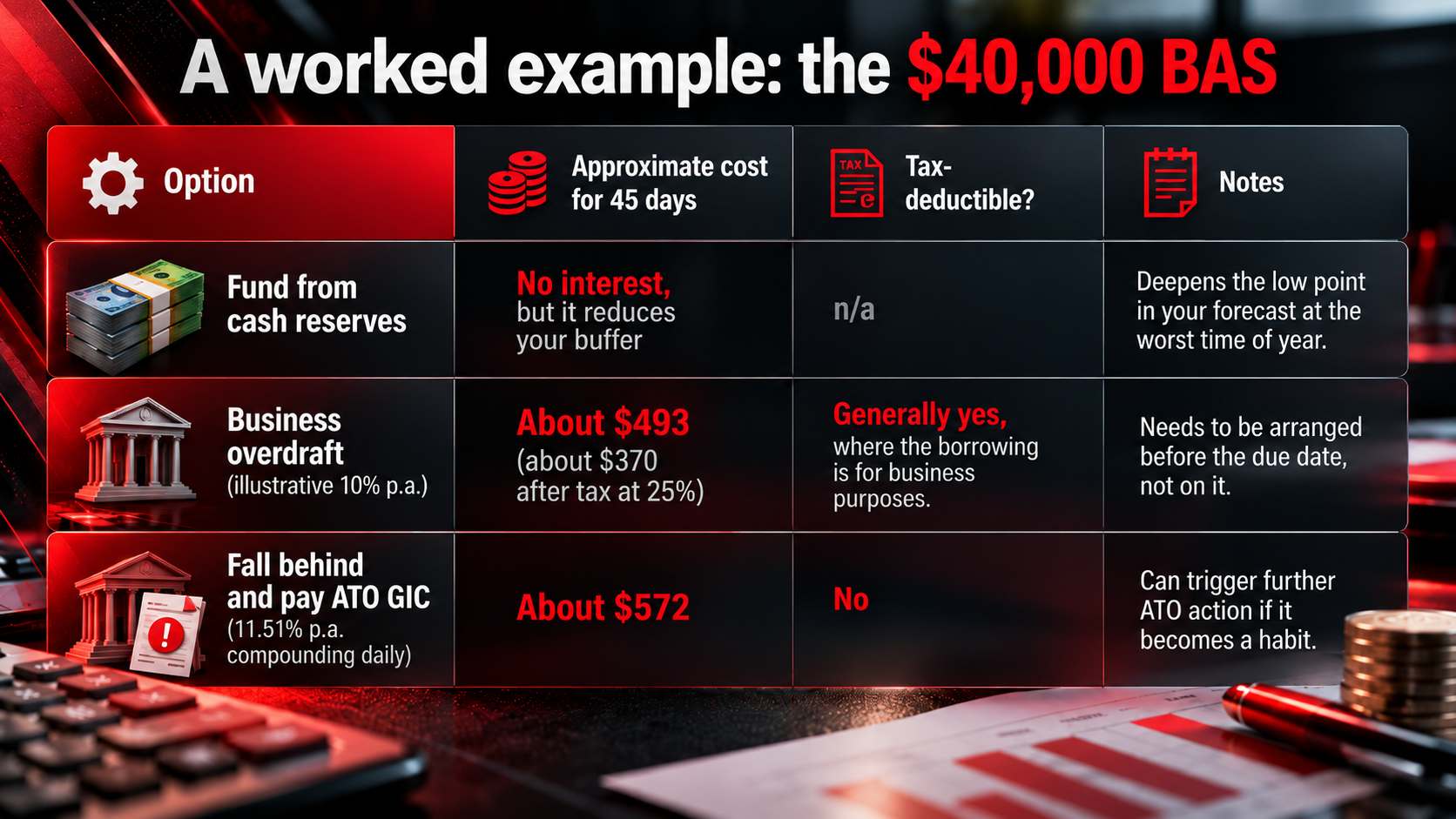
On these assumptions, paying the ATO late costs roughly 55% more than a pre-arranged overdraft once tax is factored in. And that’s before any damage to your standing with the ATO.
Interest on borrowings used to pay business tax debts may be deductible in the right circumstances, but that depends on your structure and purpose, so talk to us before relying on it.
The cheapest option is almost always the one you plan before the due date, not after it.
Find your tax-payment funding gap before December

You can’t change the ATO’s decision, but you can make sure it doesn’t catch you by surprise. We recommend a simple three-stage approach.
1. Identify
Start by working out exactly what’s affected.
- List every ATO payment you’ve made by credit card in the last 12 months: BAS, PAYG instalments, income tax and any payment-plan instalments.
- Log in to Online services for business and check whether any payment plan is linked to a card.
- Note which payments relied on the card’s interest-free period to be affordable, as opposed to simply being convenient.
2. Model
Next, work out when the cash actually has to leave your account.
- Build a rolling 13-week cash-flow forecast that runs through to at least March 2027.
- Mark the exact weeks your BAS, PAYG and payment-plan instalments fall due.
- Find the low point: the week your bank balance is at its tightest. That’s the number that matters, not the quarterly total.
- Factor in the Christmas shutdown, leave payouts and any slow-paying customers.
3. Agree
Finally, decide on your response before the due date arrives.
👉 Switch your payment plan to a bank account direct debit well before the next instalment. The ATO’s Managing your payment plan page explains how.
👉 Set money aside progressively. A separate tax account that receives a fixed percentage of every deposit removes the quarterly scramble altogether.
👉 Arrange a facility in advance if your forecast shows a genuine gap. Banks are far more receptive to a planned request than an urgent one.
👉 Talk to the ATO early if you’re facing genuine hardship. Support may be available, and an early conversation keeps far more options open than a missed payment.
This is the same discipline we encourage in our 7 Tax Planning Advantages for 2026 article: avoiding stressful tax debts starts with knowing your numbers ahead of time.
What about paying the ATO through a third-party card service?
You’ll probably start seeing ads for this soon, if you haven’t already. Several payment platforms let you pay a bill with your credit card, then pay the ATO on your behalf by bank transfer or BPAY. That keeps the card float alive, and possibly the reward points too.
It’s worth being clear about what this is. It isn’t the ATO accepting your card. It’s a separate commercial arrangement with a third party, and it needs its own assessment:
- Card processing fees on a large tax payment can quickly outweigh any rewards earned.
- Settlement times. The ATO treats a payment as made when it receives the money, not when you hit “pay”. A slow settlement can turn an on-time payment into a late one.
- Contractual risk. Read the terms closely: what happens if the platform fails to pay, pays late, or freezes your account?
- The underlying problem. If you need the float to pay your tax, the real issue is the cash-flow gap, and a payment platform doesn’t fix that.
We’re not recommending or ruling out any particular provider. Our advice is simply to get the numbers checked before you commit.
The bigger picture
The ATO’s decision is the most visible example of a broader shift. The surcharge ban is changing who absorbs the cost of card payments, and some organisations are choosing to stop taking cards rather than absorb it. Expect more suppliers, platforms and agencies to follow.
For business owners, the lesson is that cash timing is becoming less forgiving. Payday Super, non-deductible ATO interest, elevated borrowing costs and now the loss of the card float all point the same way. Cash-flow forecasting is no longer something only larger businesses need to bother with.
The good news is that this is entirely manageable with a few weeks’ notice. A short review now, before your next BAS, is far cheaper than an ATO debt in March.
The businesses that get caught won’t be the ones who couldn’t pay. They’ll be the ones who didn’t see the date coming.

Contact us here if you need assistance in unravelling the financial implications of all this in your business! We can review your upcoming tax payments, map your funding gap and help you plan your response before you change your payment method or take on alternative finance.
Frequently asked questions
Can I still pay the ATO by credit card after 30 November 2026? No. The ATO will not accept credit cards as a payment method after 30 November 2026. Other methods such as BPAY, EFT and direct debit from a bank account remain available.
What happens to my ATO payment plan if it’s linked to a credit card? You need to change to another payment method before your next instalment due after 30 November 2026. Card payments after that date will be unsuccessful and your plan may move into arrears or default.
Can I use a third-party service to pay the ATO with my credit card? Some platforms let you pay them by card and then pay the ATO by bank transfer. These are separate commercial arrangements, so check the fees, settlement times and terms before using one.
Is the ATO’s general interest charge still tax-deductible? No. GIC and SIC incurred on or after 1 July 2025 are not tax-deductible.
Does a lodgment extension give me more time to pay? A lodgment concession through a tax agent can extend the due date for some returns and statements, but it does not solve a funding shortfall. Plan for the cash as well as the lodgment.
Disclaimer
This article is for general information purposes only and does not constitute financial or tax advice. Businesses should consult their accountant before changing payment arrangements, entering an ATO payment plan or taking on finance to fund tax obligations. Figures in the worked example are illustrative only, and ATO rates and due dates may change.
Sources
- ATO: ATO to stop accepting credit cards after 30 November 2026
- ATO: Managing your payment plan
- ATO: Changes to credit card payments (Small business newsroom)
- ATO: Due dates for lodging and paying your BAS
- ATO: General interest charge (GIC) rates
- Orbitax: GIC and SIC rates for Q2 2026–27
- ATO: Denying deductions for ATO interest charges
- RBA: Review of Merchant Card Payment Costs and Surcharging, Conclusions Paper
- RBA: Conclusions Paper media release
- Finder: Surcharge ban, ATO among organisations no longer taking credit card payments
- Accountants Daily: ATO will stop accepting credit cards from December